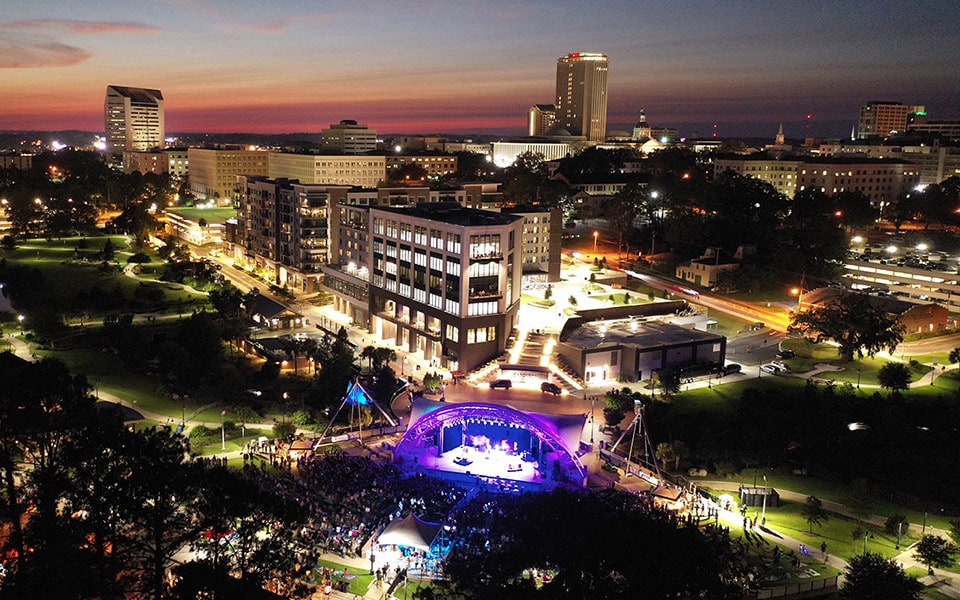
The Tallahassee area is blessed with numerous public forests. These areas can be found in parks, greenways, state and national forests or wildlife refuges. Some are within easy reach of office buildings and I feel fortunate that one such forest plot is near the northwest side of town, where I often work. A loop footpath through this area is known as the Hidden Ponds Trail and it is short enough for a perfect fifteen-minute break.
More...
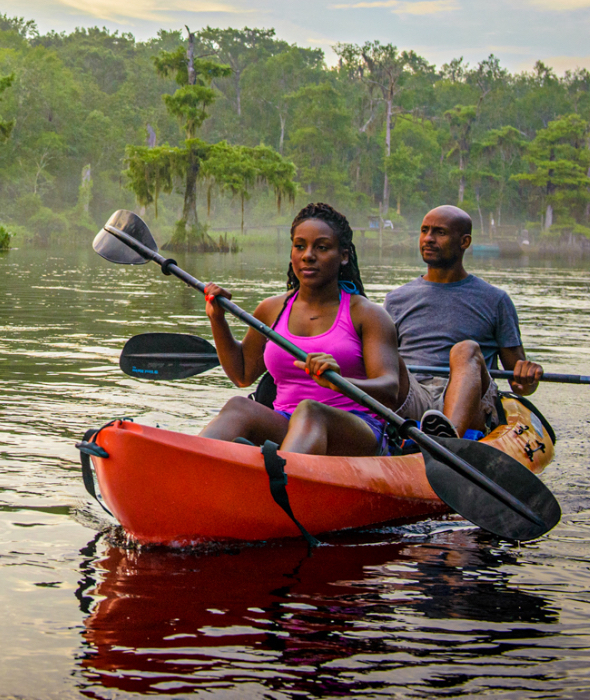
Bald eagles were our guides as we made our way down the lower Aucilla River and began skirting through a maze of tidal creeks and coves to the Pinhook River. I was with a loose-knit group of experienced paddlers who, appropriately, call themselves the Loose Cannons. It's not a club; just friends wanting to paddle together. And they gave me a good excuse to paddle to the Pinhook River in the heart of the St. Marks National Wildlife Refuge.
More...
Tallahassee's San Luis Mission Historical Site, our version of the famous Williamsburg attraction, is the focus of the first chapter in my newest book, The Great Florida Seminole Trail: Complete Guide to Seminole Indian Historic and Cultural Sites. At first glance, San Luis is an unlikely place to begin the Seminole Trail. First of all, the site's historical time period-1656 to 1704-preceded the mass migrations of Creek Indians from the north who, along with escaped slaves, would swell the population of Florida‘s Indians and form an amalgamation of people known as Seminoles. Before the Seminoles arrived, Apalachee Indians lived in north Florida with Spanish missionaries. They grew large amounts of corn to help feed the beleaguered Spanish city of St. Augustine.
When the English and their Creek Indian allies invaded in 1704, most Apalachee Indians were killed or dispersed, their former territory nearly completely denuded of people. Slowly, over the next few decades, Indians began to break away from the various Muscogee Creek bands to the north and resettle the land of the Apalachee, perhaps assimilating any Apalachee survivors still in the area. These Creek Indians settled the Apalachee capital of Anhaica and called it Tulwa-hassee, "Old Town" or "Old Fields" in acknowledgment of the former residents. They settled along rivers such as the Apalachicola, long used as trade routes for their predecessors, and they made frequent forays to the coast for seafood and items such as whelk shells. Eventually, they were called simano-li by their Creek brethren to the north, a term borrowed from the Spanish word cimarron, meaning "wild" or "runaway." Some linguists and historians postulate that the Creek definition also meant "separatist" or "those who camp at a distance."
Today, in walking the grounds of San Luis and perusing the reconstructed Spanish and Apalachee buildings, you begin to grasp a large-scale 17th century experiment in cultural exchange. A large plaza was set up with a church and priest quarters on one side and the chief's hut and an immense circular Apalachee council house on the other. Two traditional styles of architecture were at play-the Spanish waddle and daub and plank buildings, and the pole and thatch Apalachee structures.
The Apalachee council house could hold the entire adult San Luis Apalachee population of 1,400 plus guests. Other villages, along with those of nearby Creek Indians, had similar-sized council houses. To step inside the reconstructed building, with its sweet aroma of smoke and seasoned thatch, is almost dizzying. It is astonishing and worthy of Stonehenge comparisons to think these giant logs, weighing several tons each, were hoisted up by manual labor and handmade ropes. One can sense the oratory that once occurred here, along with dances and other ceremonies.
The San Luis historic site also has a museum, Spanish fort, gardens, blacksmith shop and other attractions. Living history interpreters in period costume are often stationed at various points, especially on weekends and special events. For outdoor lovers, there is a scenic hiking trail along a forested hillside and stream worthy of exploration.
On Saturday, April 6th, at 10:30 a.m., I'm giving a talk at Mission San Luis about the Great Florida Seminole Trail. Feel free to come out. The lecture is free to members and costs the price of admission for non-members. And be sure to roam the grounds afterwards and you'll see why San Luis is worthy of Williamsburg comparisons.
More...The Florida Panhandle's remote Torreya State Park near Bristol offers more than adventure and wilderness exploration. When I visit, I am a pilgrim drawn to the sacred. The bluffs and ravines within and around this north Florida gem are so unique that some local residents had gone so far as to claim it was the original Garden of Eden, the one where Adam romped with Eve in a natural paradise until lured by Satan to bite the forbidden apple.
Almost every family of fruit tree is represented in the 2,500 plus-acre preserve, from pear to fig. Even the apple--Southern crabapple to be exact--can be found in hollows and deep ravines, along the shores of gold-tinted creeks. Only don't try eating this fruit straight from the branch. Its bitterness will long linger on the palate, and pucker the lips.
On my visits to Eden, I am always astounded by the abrupt change in scenery and topography when I near Torreya's gates. Miles of rolling pine farms, where planted sand pines grow in monotonous, even rows, give way to expansive arms of moss-bearded live oaks. I drive around a bend and sharply descend, experiencing a rare if not imagined taste of Florida mountain driving.
At road's end, a reconstructed antebellum plantation house right out of Gone With the Wind stands atop a tall bluff overlooking the wide Apalachicola River. Touring the structure, I often marvel at the rich river history depicted by drawings and photographs-Indian renegades, riverboat pirates, "Mississippi" gamblers, paddlewheelers and Civil War.
More than fifteen miles of hiking trails wind along the Apalachicola River and interior ravines, and newly acquired adjacent lands will likely open up new hiking opportunities. The terrain is surprisingly steep and the day hiker has the choice of taking one of two seven-mile loop trails-both if one seeks a strenuous challenge. Three backcountry campsites have been strategically placed for those seeking to stretch out the experience.
I often hike the river loop. I usually begin at the mansion and soon descend the bluff past sites of Civil War battery placements once geared for shooting Union boats. The guns never saw action. The raptor's view of this valley remained peaceful during the war years.
Moving onward, the terrain becomes steep. Large roots finger over the trail, having created earthen steps in angled hillsides. Broad-headed skinks scurry through brown leaf mold. If it is spring, they move through fallen blossoms of dogwood and flame azalea. Large white atamasco lilies and trillium flowers sometimes fringe the trail along with bright red carpets of Indian pink. Needle palm, river cane and the taller oak leaf hydrangea dominate the larger understory of flora. Overhead, huge magnolia, beech, white oak and sweetgum trees form lush, shaded canopies.
Deep in the ravines, amid tiny fingerlings of cascading water, is where I usually find the torreya tree, otherwise known as "stinking cedar." Its dark green, waxy needles fan symmetrically on either side of a spindly trunk. This was the famous gopherwood that built the ark, Calloway maintained. The wood's resin has a pungent odor, thus the "stinking cedar" moniker, something Noah would surely have found repulsive when mixed with other smells in an animal-packed ark. The torreya, along with the similar looking Florida yew, grows naturally nowhere else in the world. Once cut for fence posts, a fungal blight now strikes down each torreya tree before they reach maturity, threatening this rare species with extinction in the wild.
Torreya Park is where I often stretch my botanical knowledge. If this area is not the biblical Eden, then it surely is a botanical one. There is Appalachian mountain laurel, Carolina poplar, ashe magnolia, bloodroot and downy rattlesnake plantain, all species more commonly found in Southern Appalachia. Several seed varieties may have floated down the Apalachicola, the river being the only Florida watercourse with mountain origins. Not surprisingly, in the year 2000, the Nature Conservancy highlighted the Apalachicola River bluffs and ravines as a major reason north Florida was selected as one of six regions in the United States having the highest levels of biodiversity.
Eden is best enjoyed with a slight nip in the air, when all-encompassing breezes sweep across the bluffs as if sent by gods.
Some day, when I am completely gray-haired and in the autumn of life, I will visit Torreya to hike the same trails and touch the same trees of my youth. I will smell flowers of a new spring, sense the alpha and omega of my bodily existence, and grasp the unceasing life force. Isn't that what an Eden is for-a barometer of existence, a place for searching and finding, a place to jump off from?
Torreya is Eden. It is completely unique, and yet, there are a thousand more like it, in forests and rivers, coastlines, swamps, mountains and deserts. It is found in small nooks of greenery, whether a city park or backyard, porch or rooftop garden. It is anywhere people have yearned for the natural, and have found it. It is, simply, Eden.
More...
Paddlers, get your sea kayaks ready! Wakulla County is putting together the Apalachee Bay Maritime Heritage Paddling Trail System, a set of ten saltwater paddling trails for both beginning and experienced paddlers. Trail lengths range from three to eight miles through a variety of coastal habitats.
More...Since I coordinate most of the state's designated paddling trails for the Florida Office of Greenways and Trails, many people want to know my favorite river. I try to be coy in answering. After all, Florida might have the largest number of scenic and diverse paddling trails of any state in the nation. Plus, my evaluation is subjective and highly influenced by geography. While I have sampled many of Florida's streams, the rivers I paddle frequently are the ones within an hour's drive of my home near Tallahassee, so naturally my favorite would be one of those.
More...Tallahassee has a big backyard. That's because more than half a million acres of the Apalachicola National Forest begins around the airport and extends west to the Apalachicola River and south to Tate's Hell Swamp near the coast. Unspoiled rivers course through vast stands of cypress and pine, many of which offer prime paddling opportunities, but if you're seeking an outing close to home, a string of ponds and lakes and some of the nicest longleaf pine sandhills found anywhere exist as a partial beltway of natural Florida around the capital city.
More...I recently paddled the Wekiva River/Rock Springs Run, one of Florida's two federally designated wild and scenic rivers. Only a few miles north of Orlando, it was difficult to realize that more than two million people live within thirty miles of the river system. The water was sparkling clear, turtles sunned on logs, limpkins probed for apple snails in vast mats of native spadderdock and pennyroyal, and there was not a speck of invasive hydrilla in sight. "The Wekiva is considered one of the most protected waters in the state," Wekiva aquatic preserve manager Deborah Shelley said, "but we still have challenges in the basin."
More...Trees that talk aren't reserved entirely for movies and fantasy books. They are also found at the Bear Creek Educational Forest along Highway 267 in Gadsden County. The Florida Forest Service has put together an impressive push button story program about trees in the forest along a paved self-discovery trail. And beyond the paved trail along five miles of hiking trails, numerous signs continue the education about our area's native trees and shrubs. It's a great way to learn while enjoying the sights and smells of a mature forest along with clear sand-bottomed creeks that emerge from three-sided sand canyons known as steepheads.
More..."Octopus can really mess with your head, and not always in a good way," Jack Rudloe said, standing beside one the large saltwater tanks at Gulf Specimen Marine Laboratory in Panacea. "They are extremely intelligent, and if they lived longer, we might be in trouble." Rudloe described how octopus at the lab played with various toys, how they were escape artists, and how they started waving at a visiting marine scientist whenever she walked past.
More...